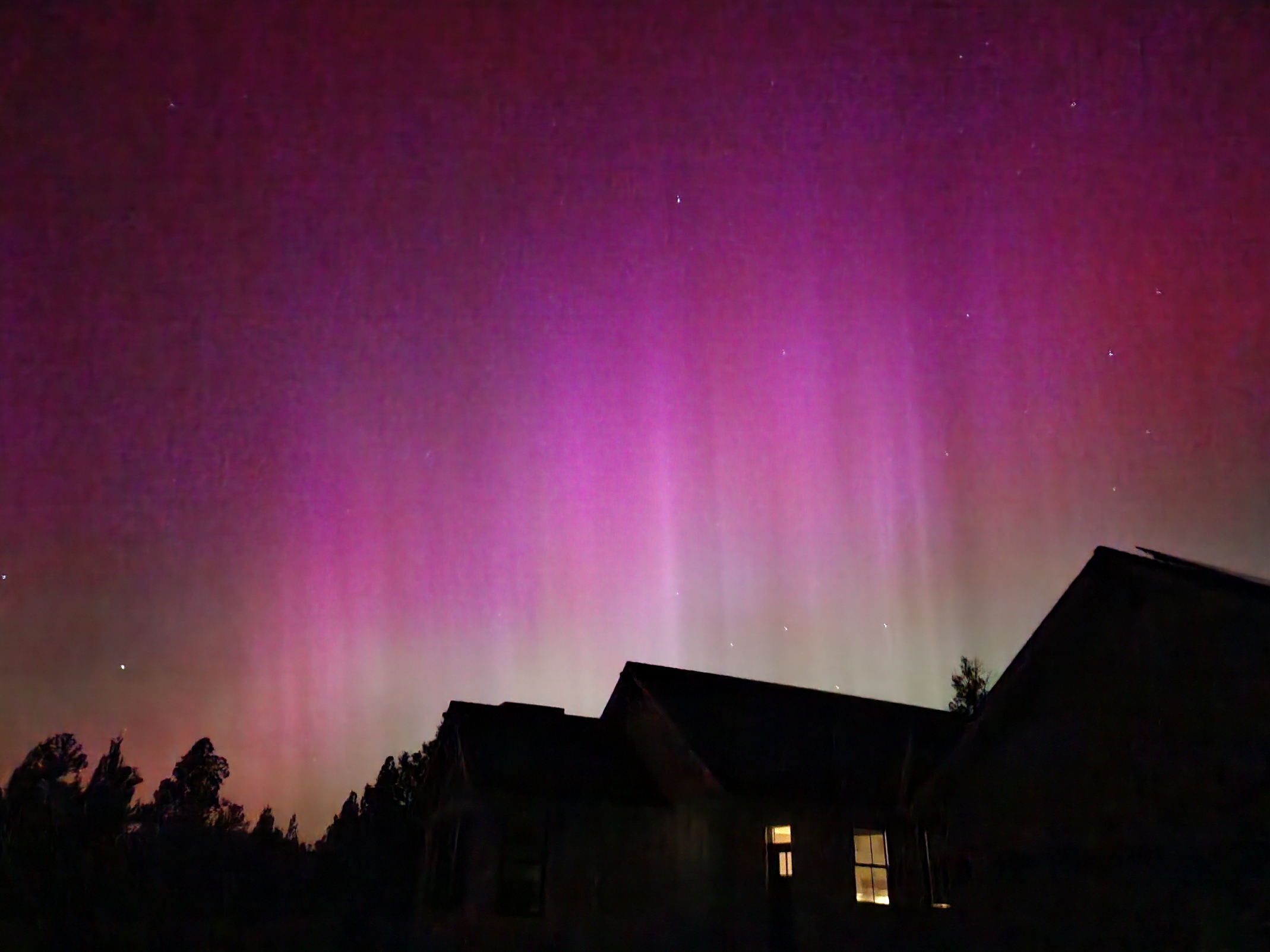
The great aurora of May 2024
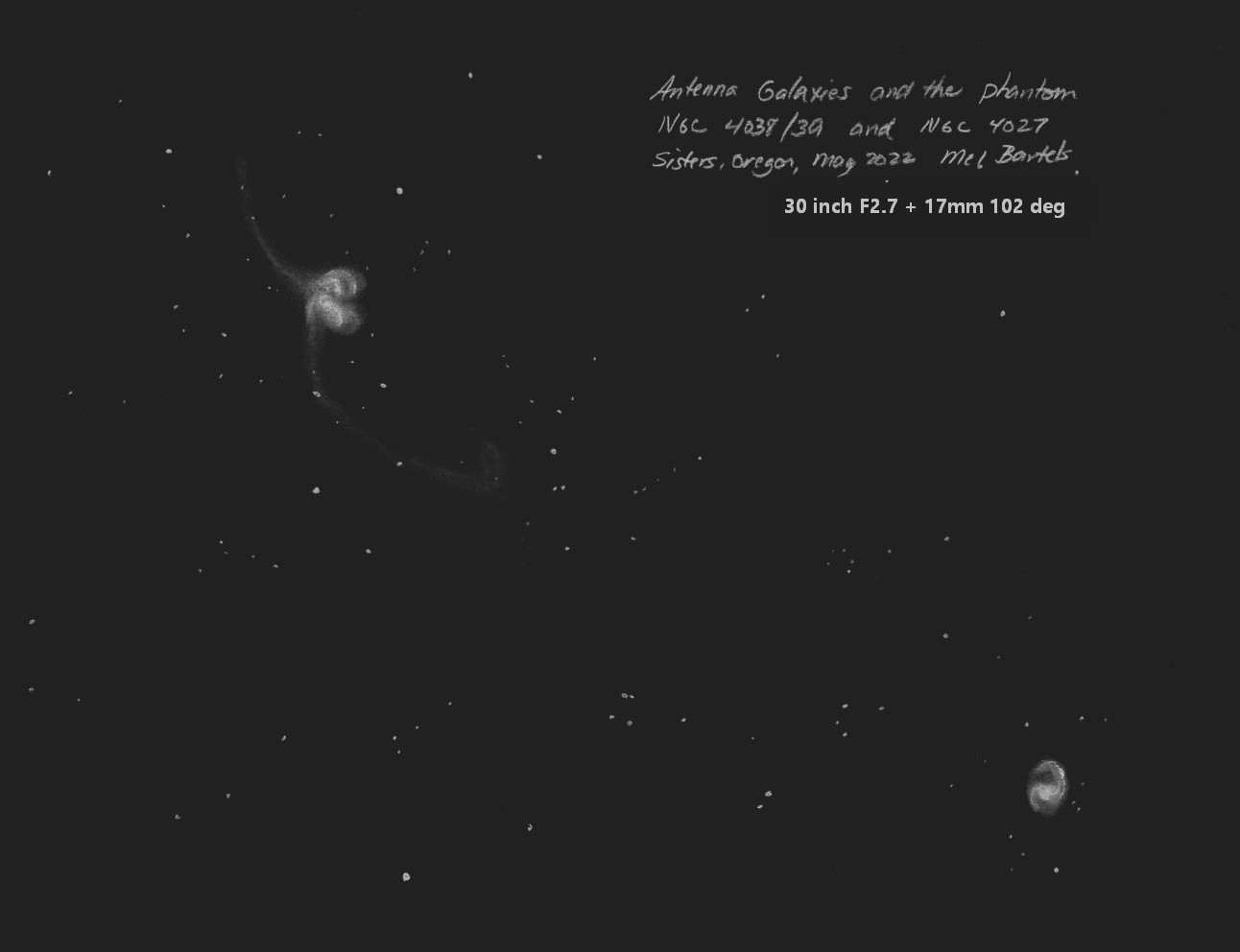
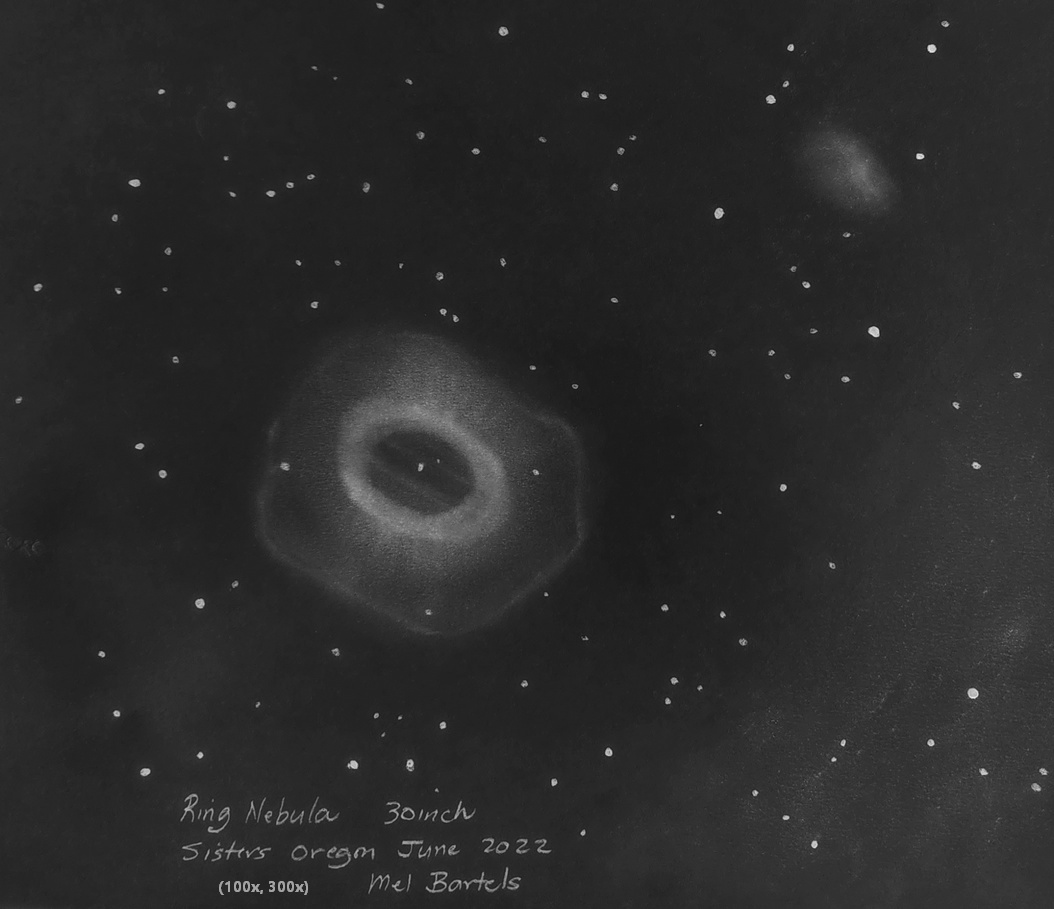

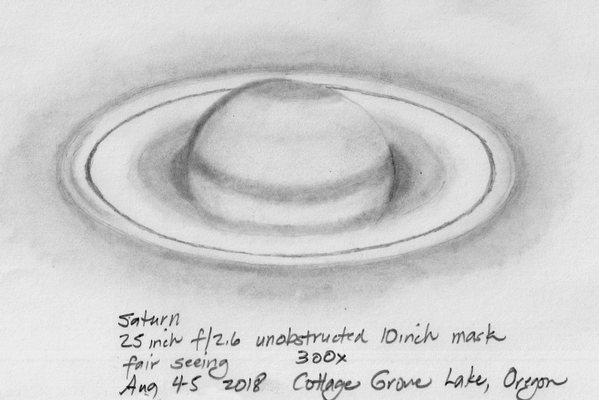

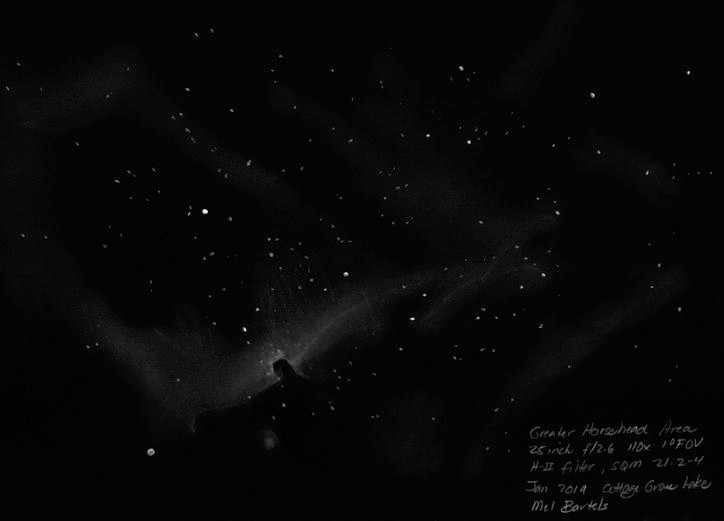
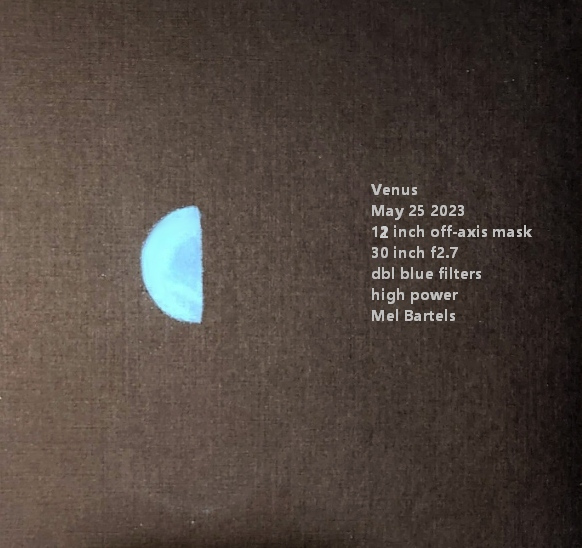
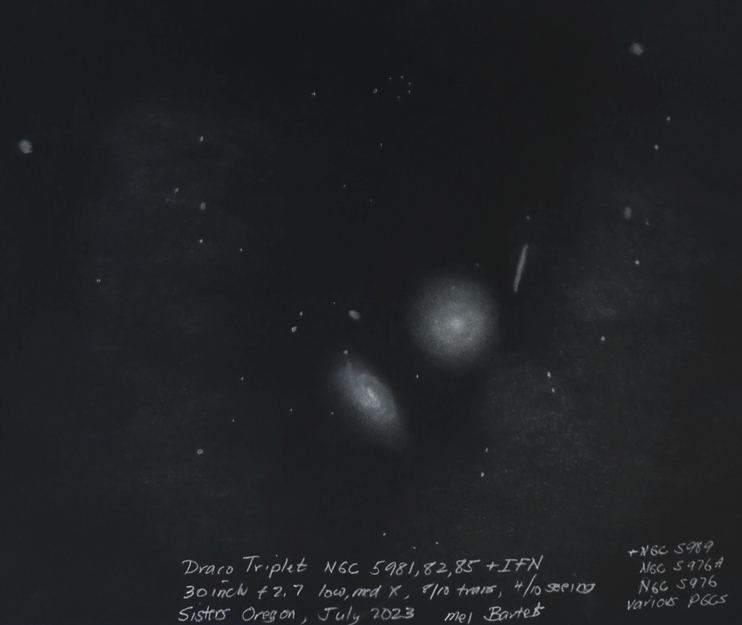

More drawings can be found here.
John Dobson brought us the Dobsonian telescope: big aperture bright views. TeleVue brought us coma correctors and wide angle eyepieces. My vision is combining these two innovations by developing thin fast meniscus silvered mirror technology on 3 axis mounts.
So that a standard Dobsonian 16 inch F5 with its one degree field of view morphs into a
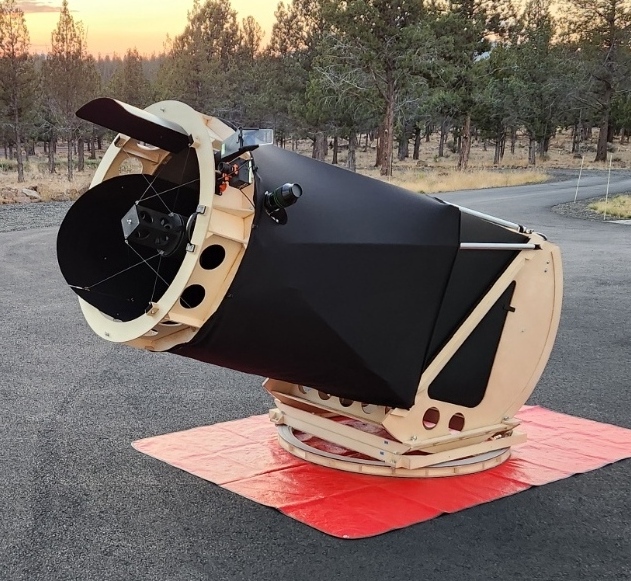
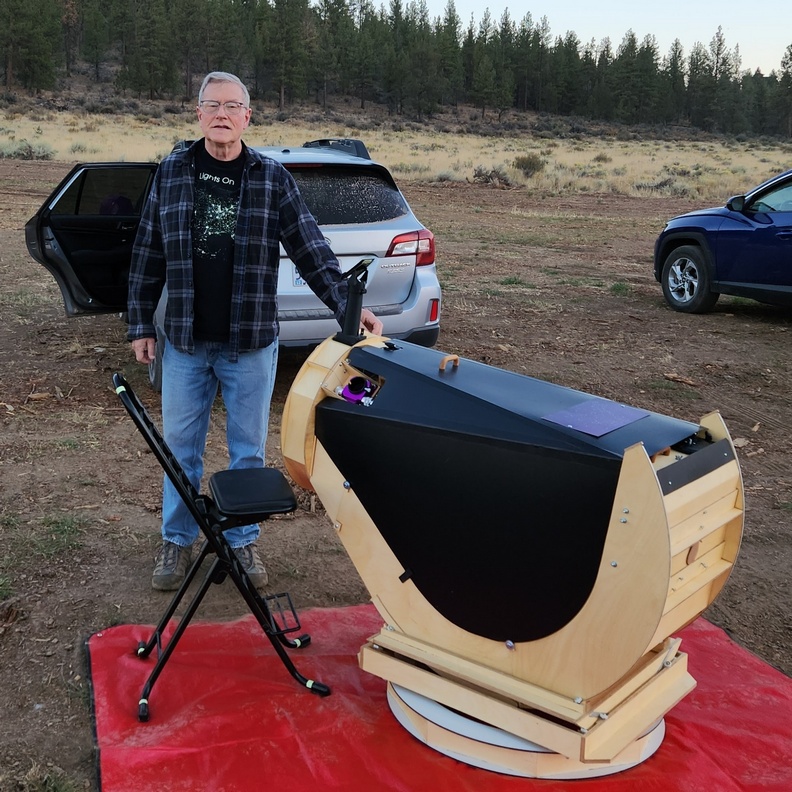
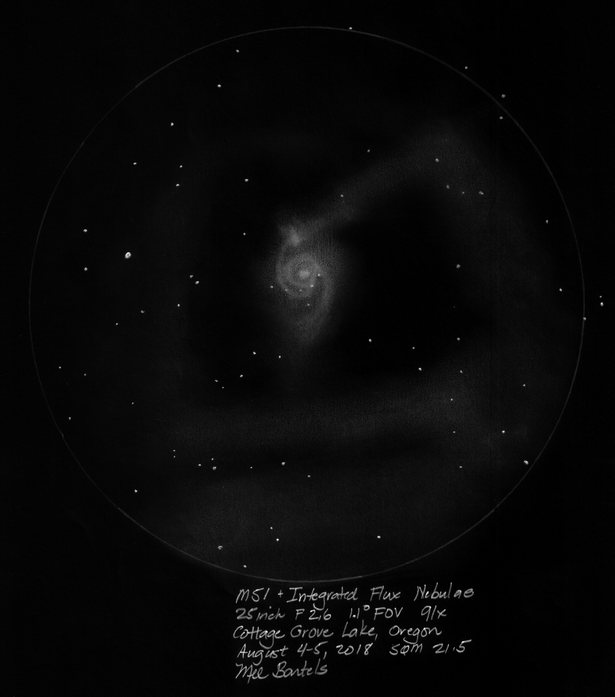
In 2018 I lept into large thin meniscus mirrors, completing the 25x1/2 inch [635x13mm] F2.6, grinding, polishing and parabolizing a slumped meniscus shaped mirror blank from Greg Wilhite. I designed a lightweight 3-axis mounting to go with the lightweight mirror with a total weight of 75 pounds [34kg].
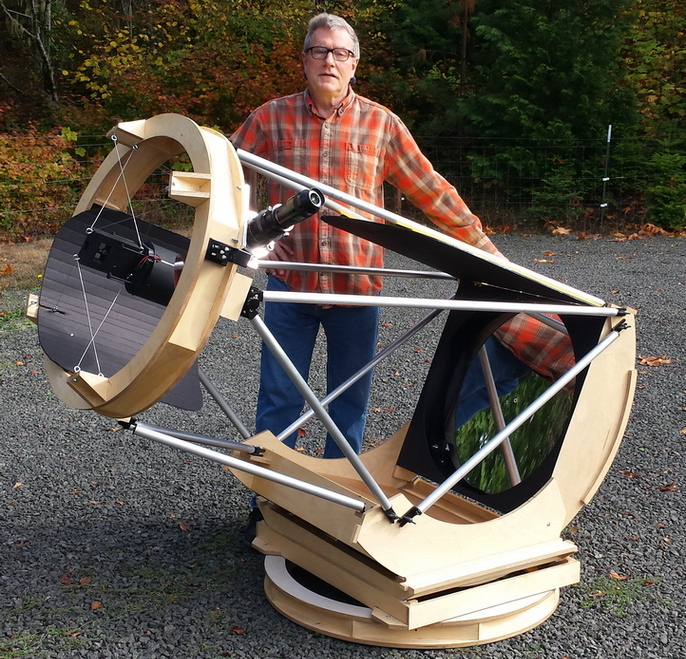
In 2008 my large thin fast meniscus mirror journey began with the ZipDob, a 13 inch F3.0. Slumped blank supplied by Richard Schwartz.
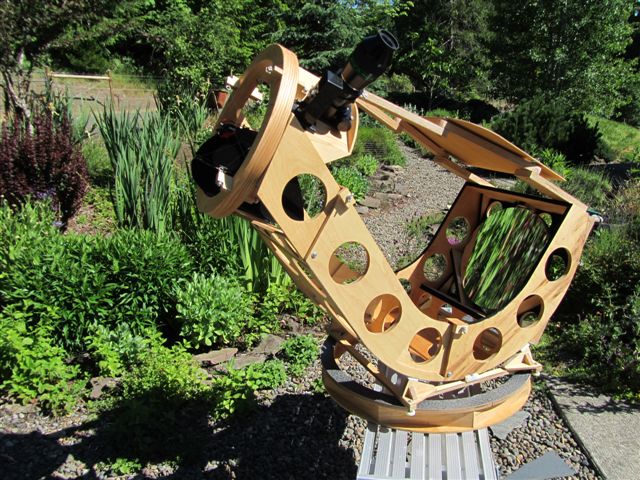
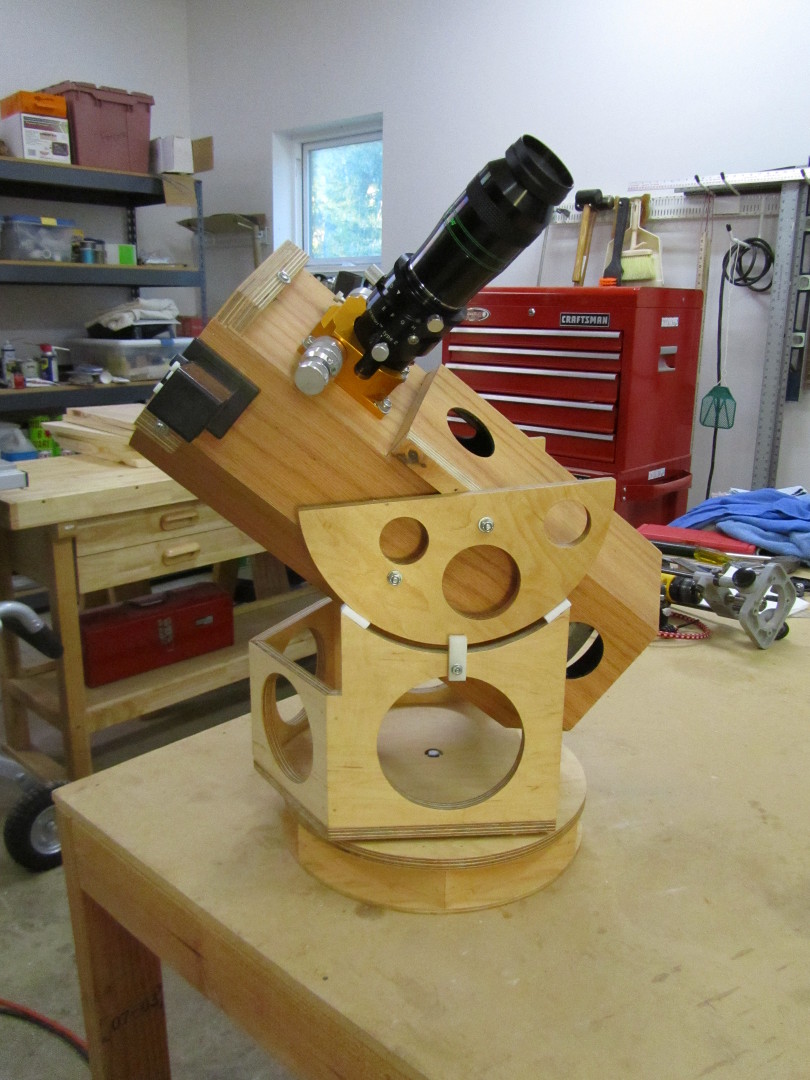
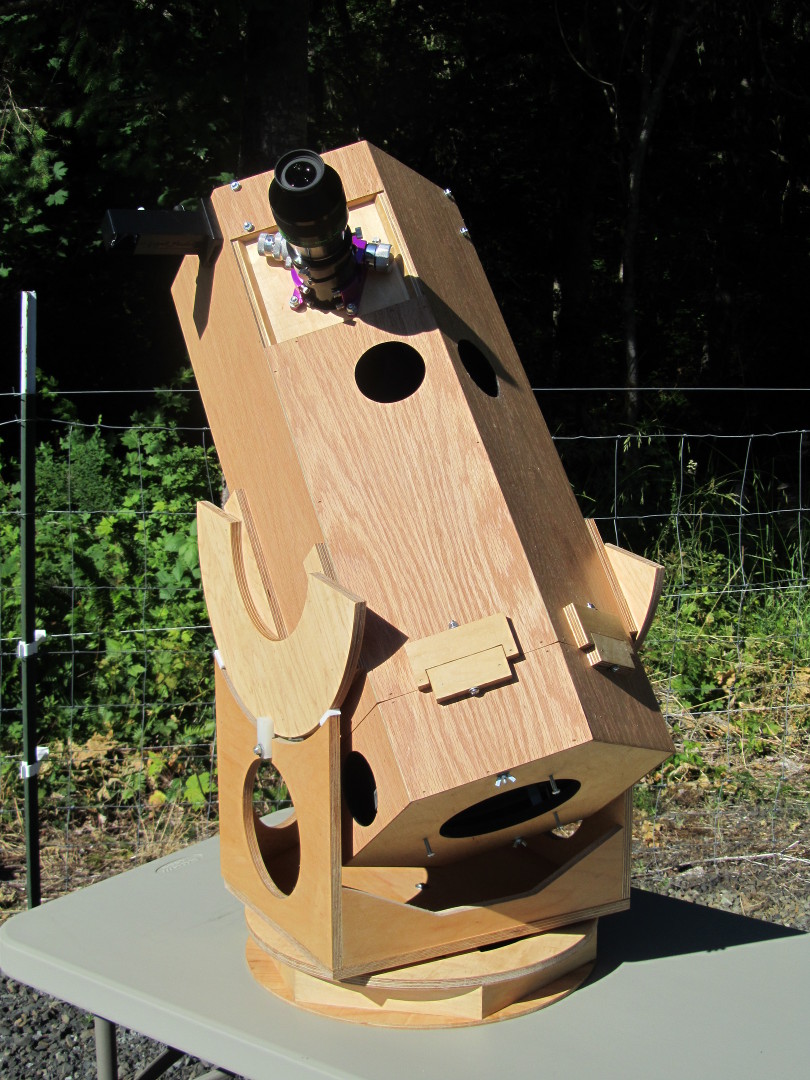
I quickly followed with the 6 inch F2.8 and 10.5 inch [267x19mm] F2.7 mirrors (another Richard Schwartz slumped meniscus blank) to gain more experience.
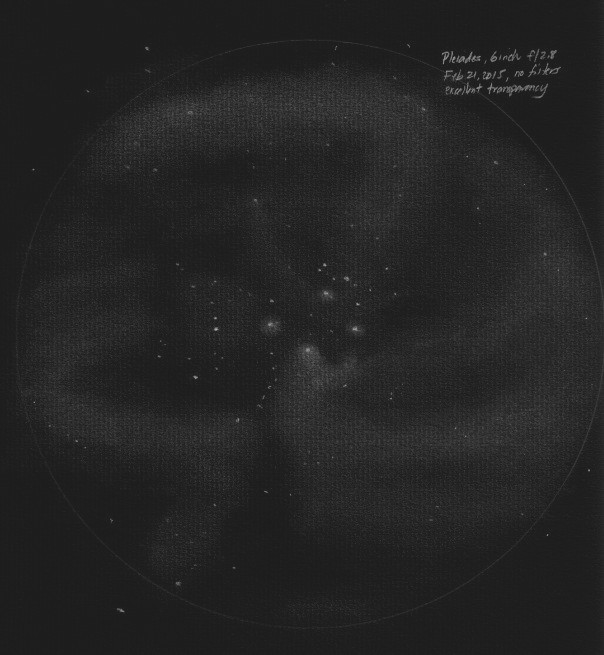
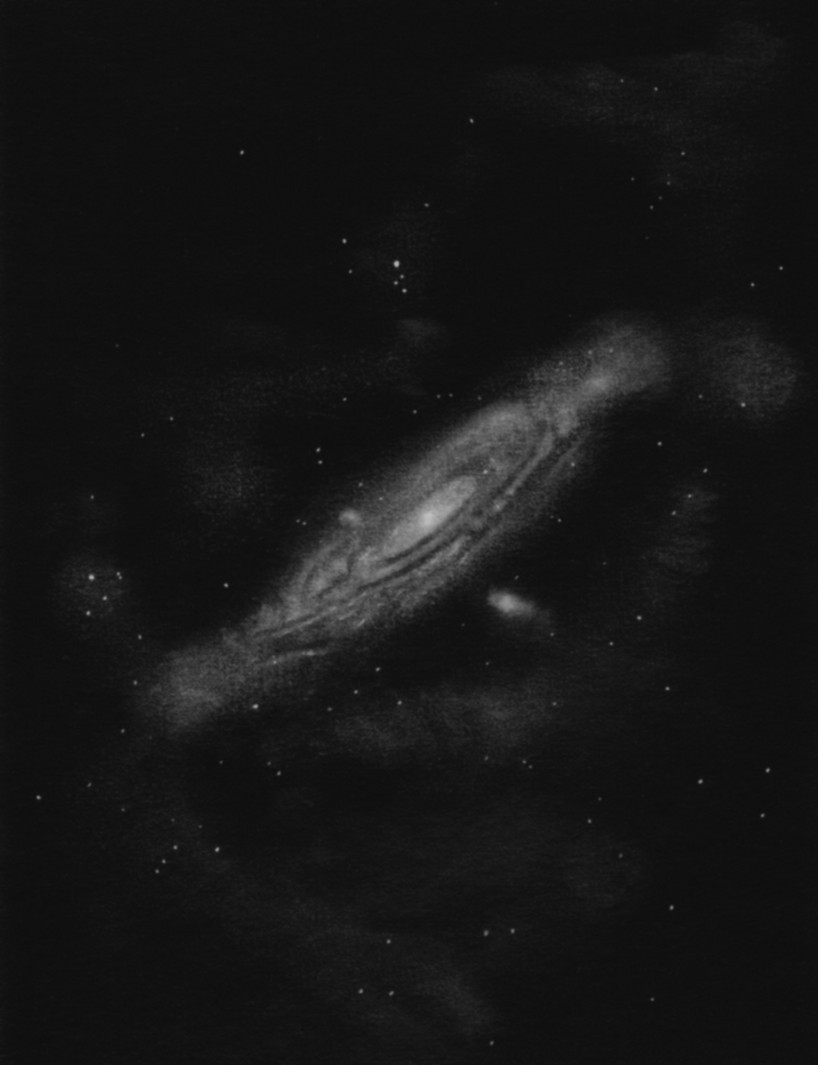
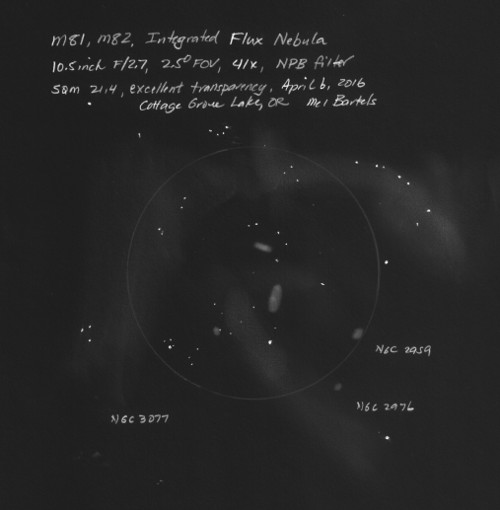
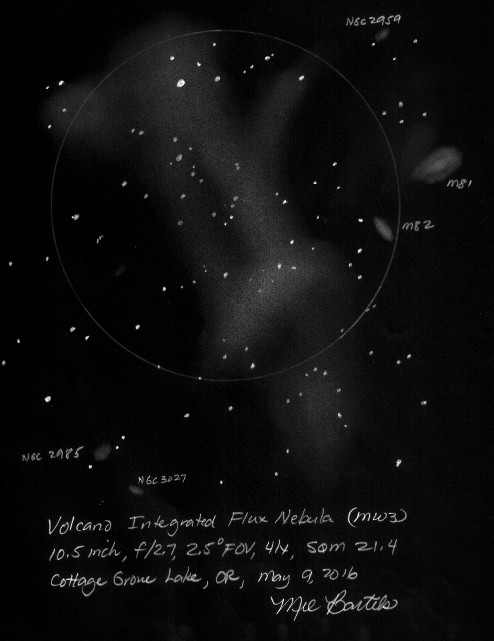
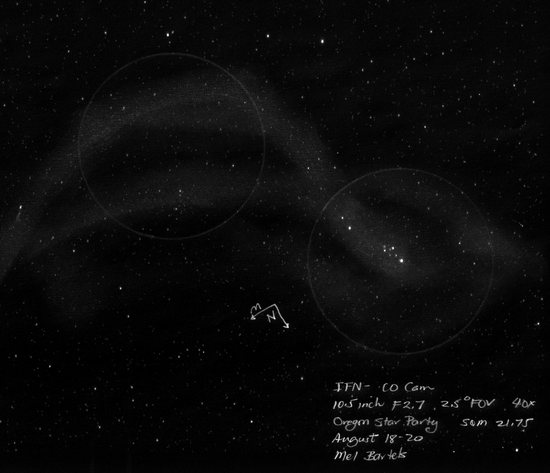
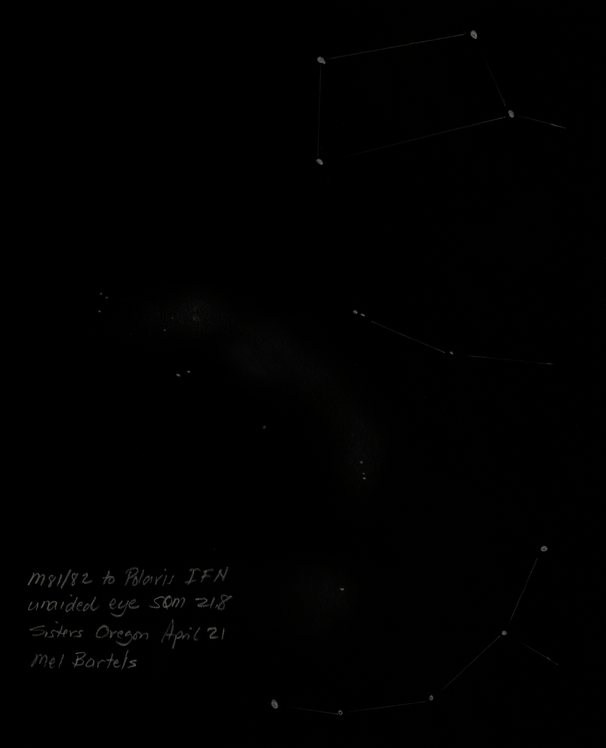
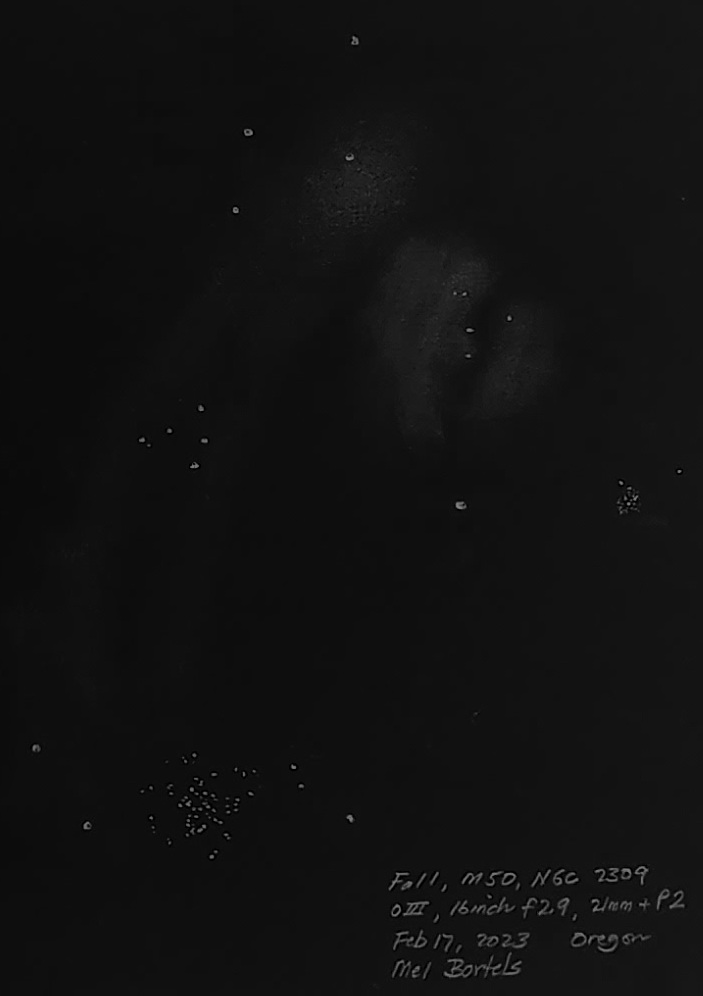
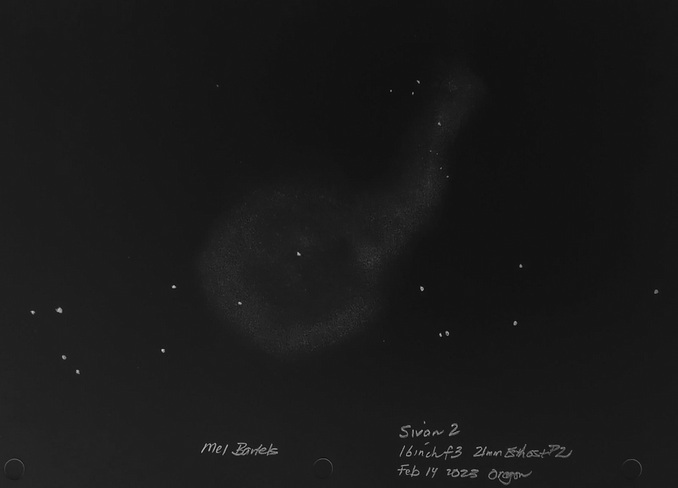
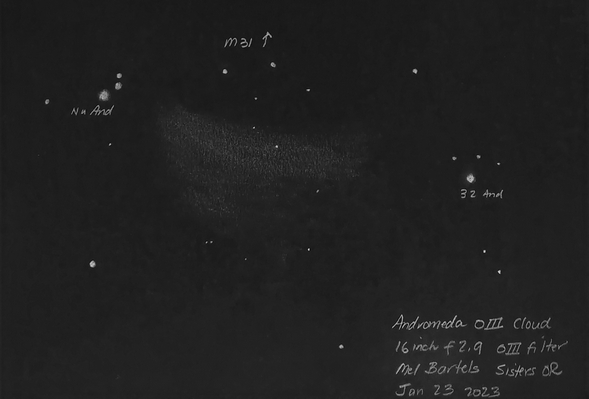
After rediscovering the Pleiades Bubble and finding the Andromeda Twist, and having read Mandel's inspiring story of discovering IFN with deep digital camera images, one night I, on a whim, aimed my 10.5 inch F2.7 scope at M81/M82, wondering if just maybe in my wildest imagination I could detect IFN visually. I put my eye to the eyepiece: there were clouds of nebulosity everywhere. Stunned, I looked up at the sky and peered into the forest a few feet away. Was I the first on Earth to detect IFN visually? Not quite, as it turns out. William Herschel, perhaps the greatest observer of all time, saw a few of them, his little known 52 Nebulous Regions. For the whole story, see my webpage on Herschel's Ghosts.
Class notes for the 16F3 master meniscus mirror making class.
My Dobson era begin in 1981 with a bang: a 24 inch f5.5. I built my first grinding machine and worked on 20 inch f/4, 20 inch f/5, 24 inch f/6, 25 inch f/6 and 30 inch f/4 mirrors.
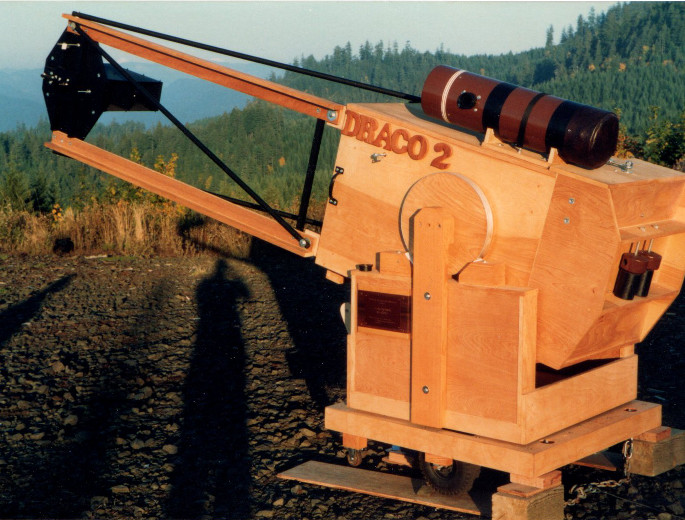
In 2003 I finished construction of a new ultralight design that I call the Trilateral or TriDob, based on the use of triangles in the upper end, the trusses and the rocker with altitude bearings. Later I built a small 6 inch F4 version of the Tri-Dob.
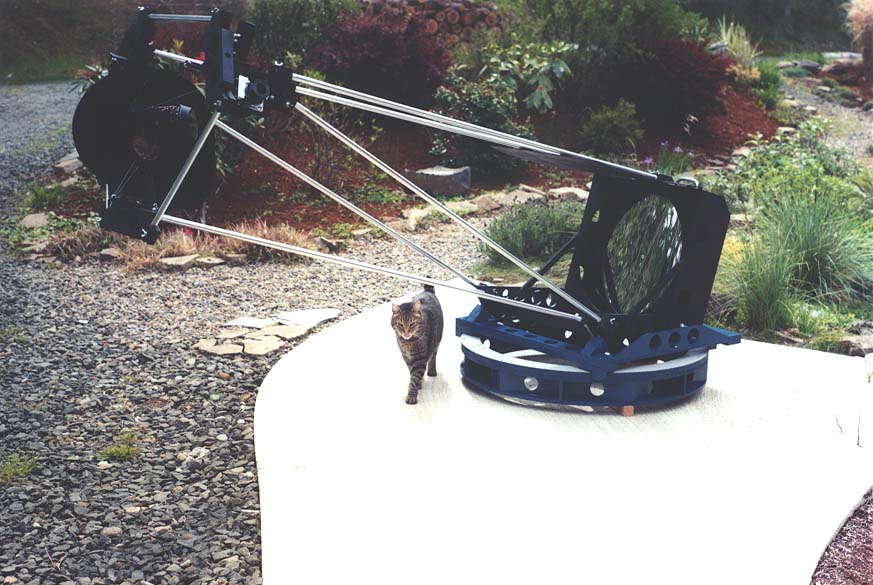
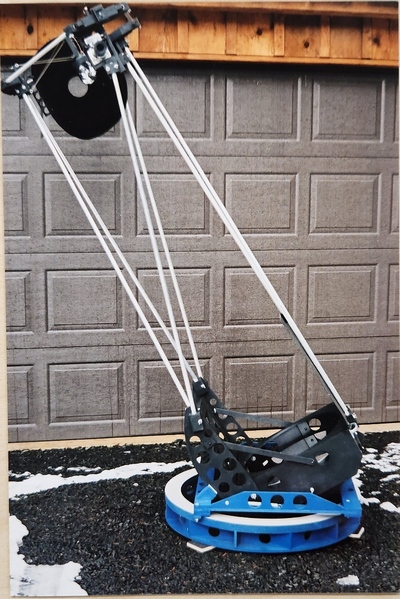
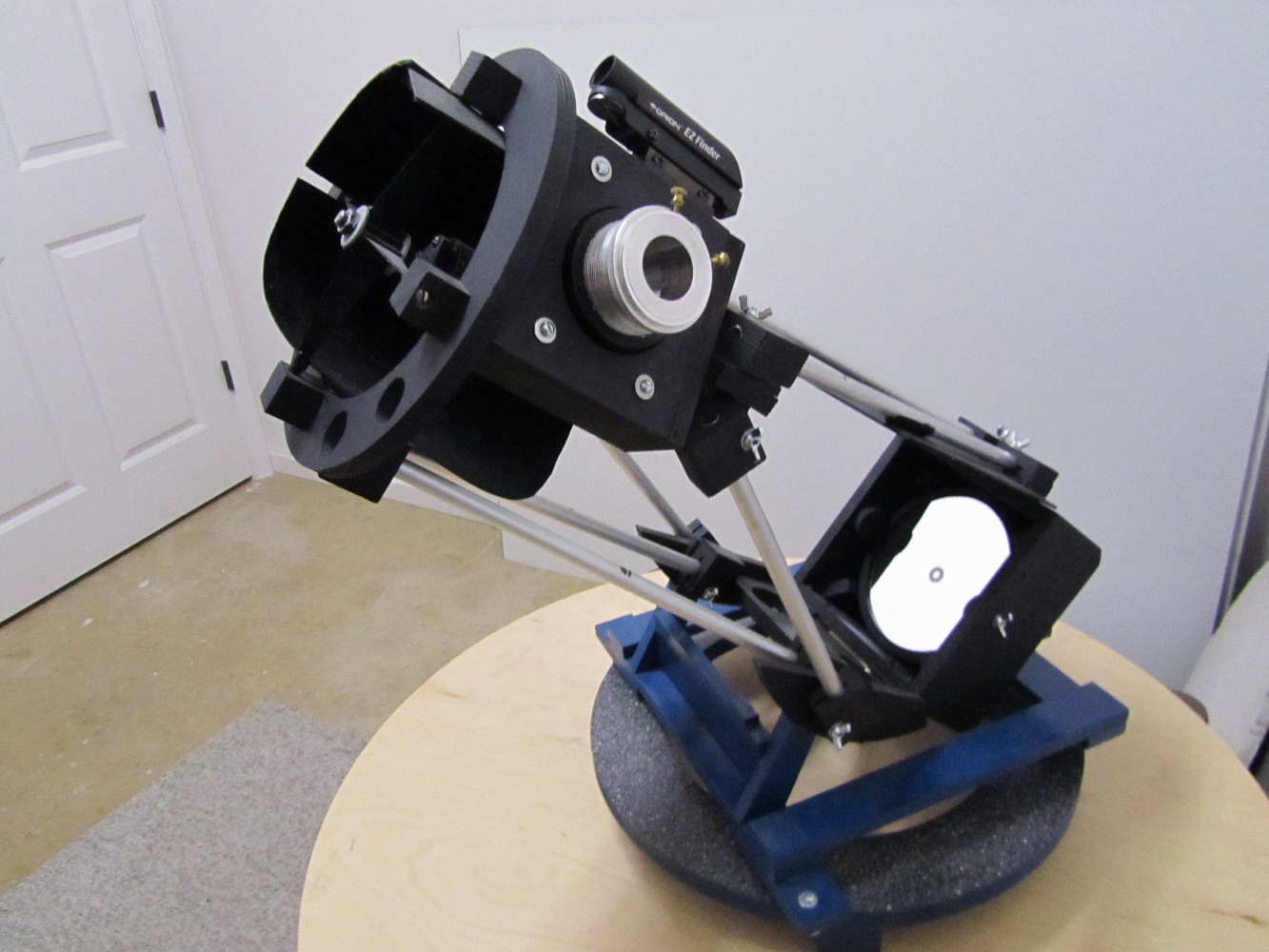
I began developing an open source software and hardware computerized control system for telescopes in the mid 1980's that incorporated software and hardware innovations. Pat Sweeney designed a PCB in the late 1990's. And in 2000 my wife Barbara and I incorporated BBAstroDesigns, Inc. to sell kits and finished boards.
I finished my 20 inch fully computerized telescope in 1994 with which I took some early CCD images. It won a RTMC Merit Award in 1995. I subsequently created lighter versions.
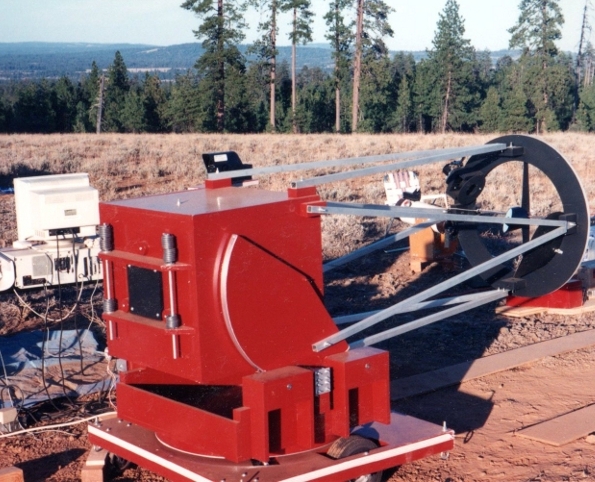
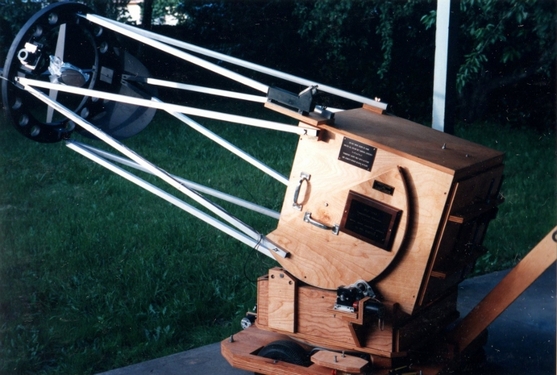
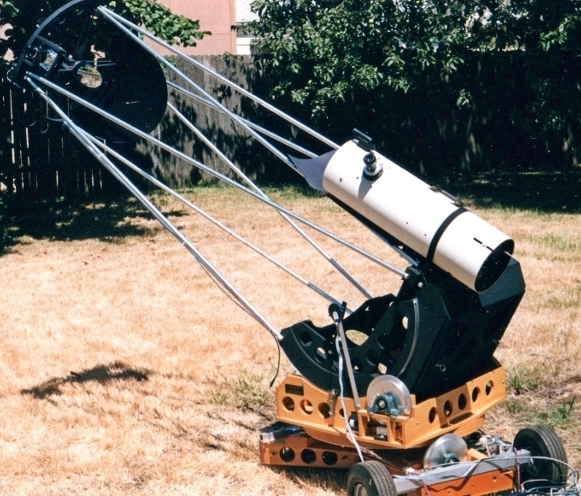
A 12 inch F6, 10 inch F5 Dob and a 8 inch F6 Dob.
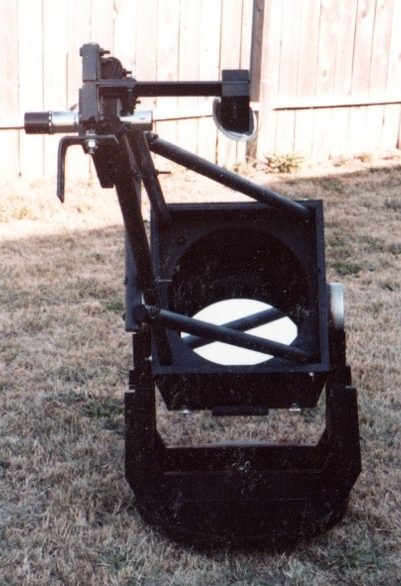
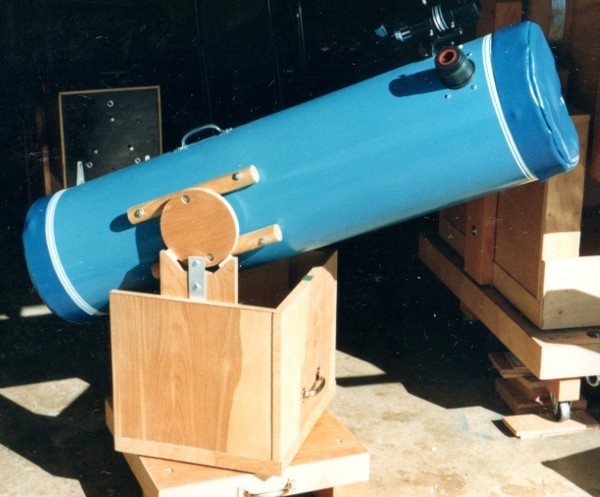
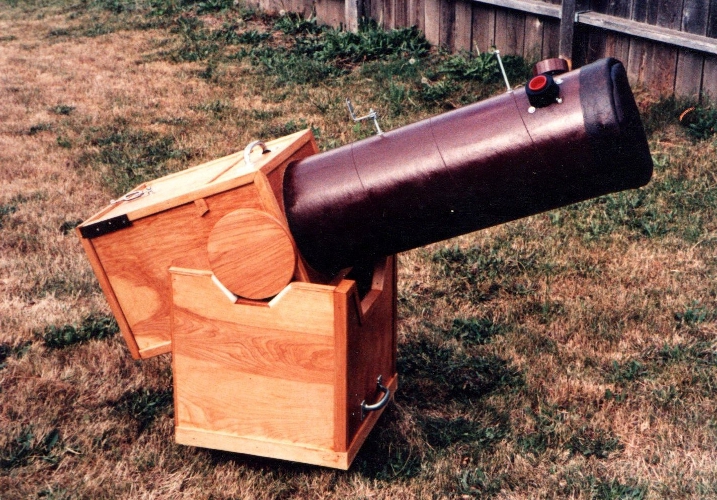
A 6 inch F4, a 5 inch F5 with homemade Crayford focuser and a 4 inch F4 handheld.
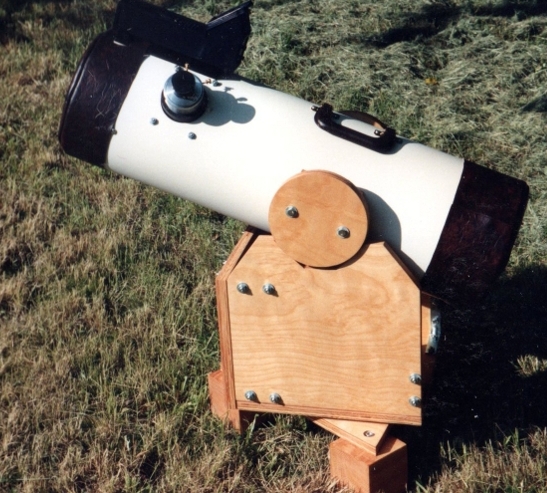
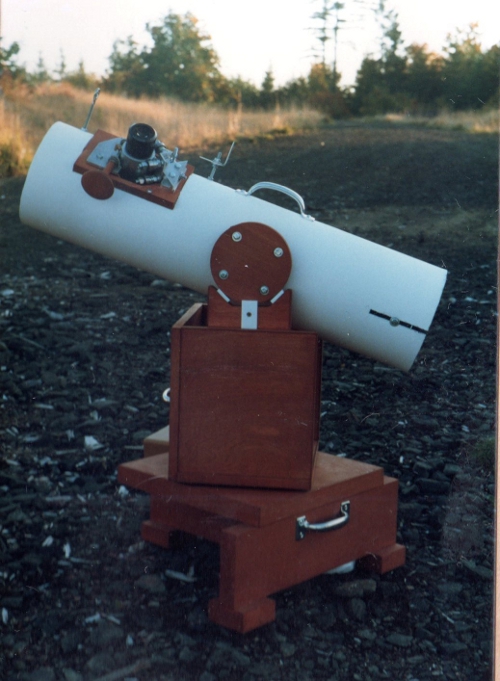
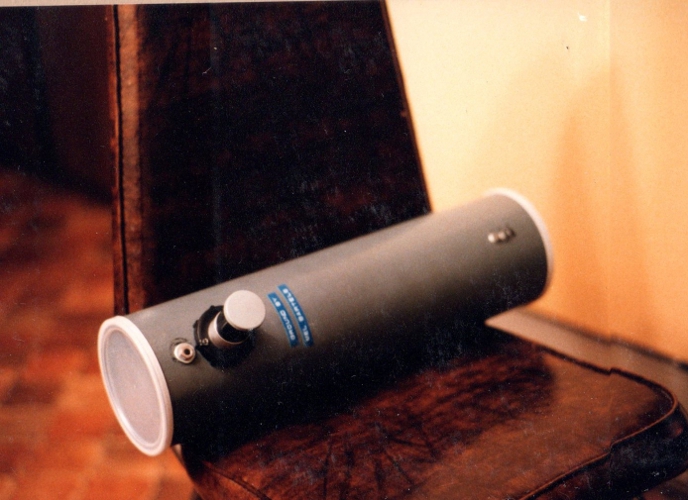
A 6 inch travel scope that I took to Africa.
A 17.5 inch F4.5 that I helped the owner build.
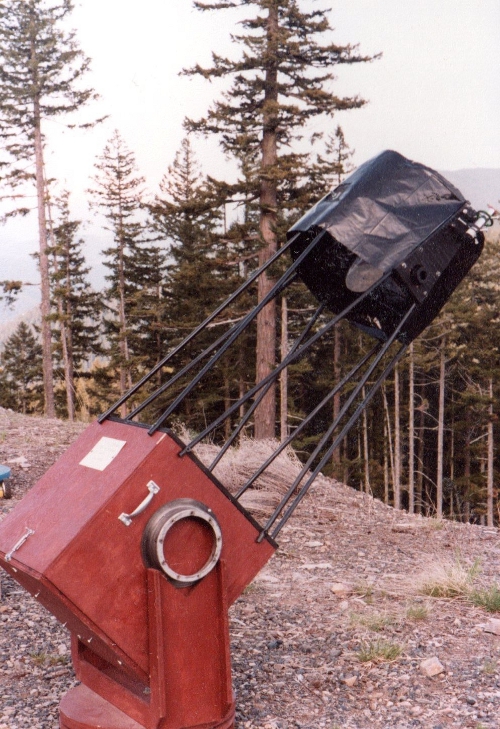
I began in the 1960's and 1970's by building Palomar 200 inch inspired horseshoe mounted reflectors equipped with homemade cold cameras, processing black and white Tri-X negatives and color Ektachrome slides in my darkroom. Here are my 14 inch F5, 10 inch inch F5, 8 inch F7 and 17.5 inch F4.5 equatorials.
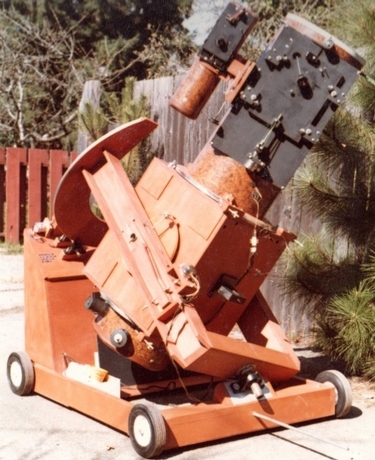
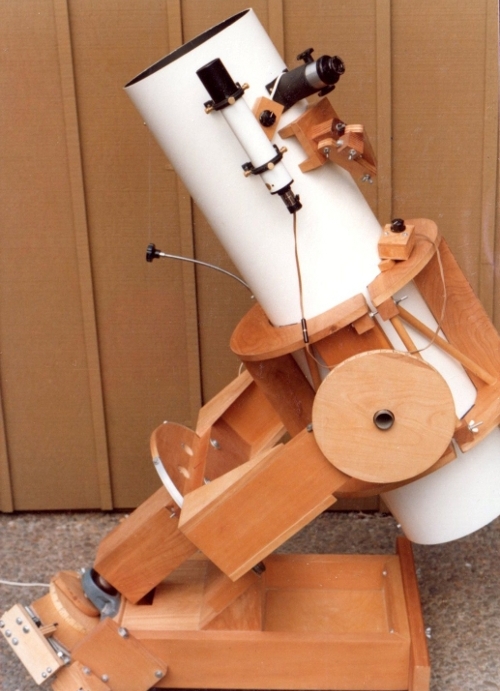
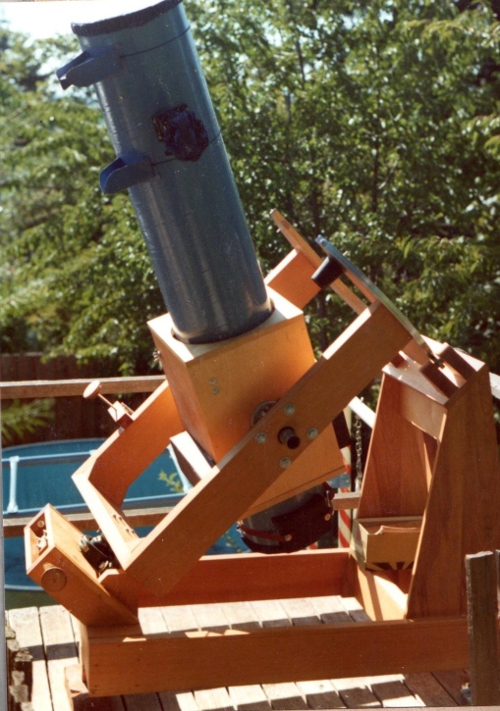
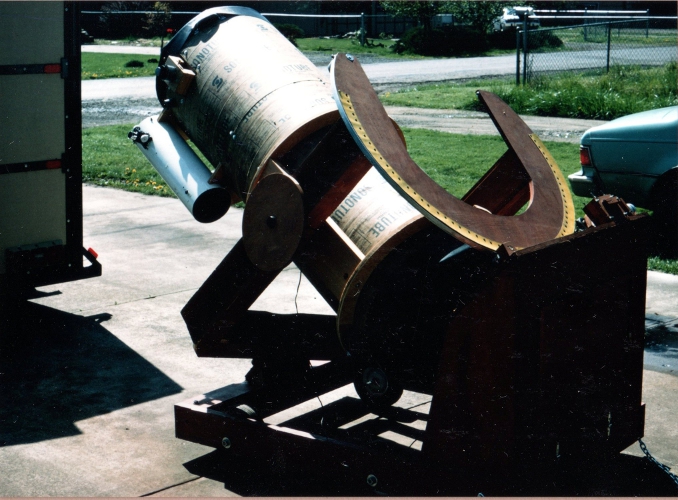
Scopes where I made the mirror (12 inch F4), Rob Adams designed the tilted Dobsonian equatorial mounting. A scope that I built the drive system (10 inch F5 torque tube), Greg Babcock designed and built the telescope.
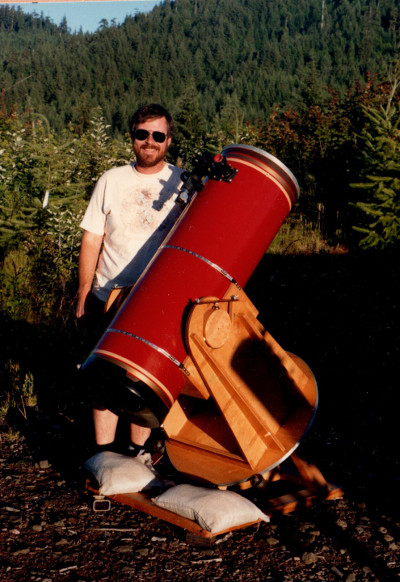
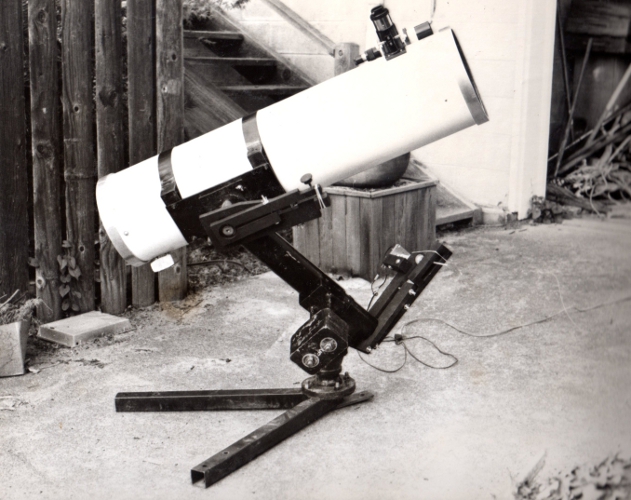
A lensless Schmidt camera that I built, piggybacking it on a 14 inch F5.
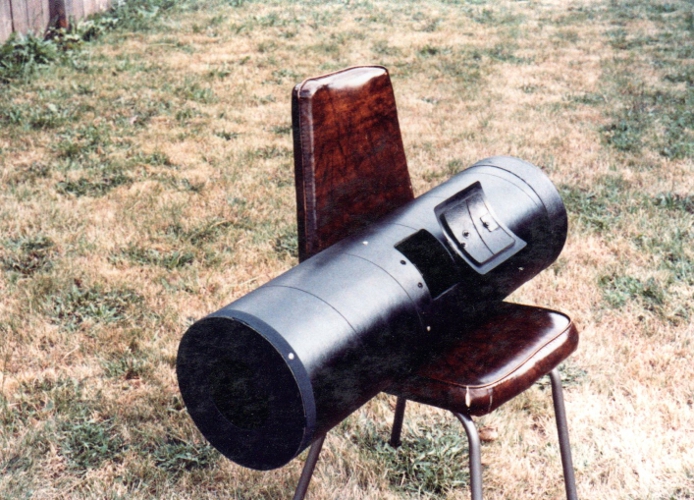
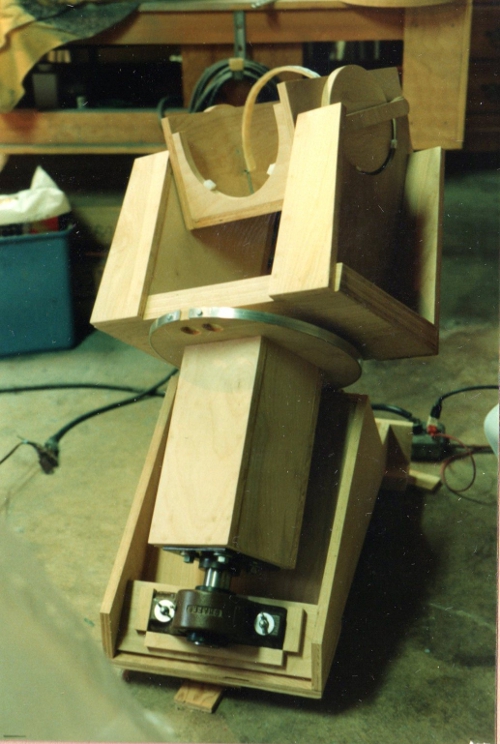
A fork mounting for a 6 inch.
Newtonian reflecting telescope designer...
...what does a telescope do
...telescope parts
...how does a telescope work
......scope performance as a function of exit pupil
......focal length and aperture
......focal ratios
......apparent size and image size
......field of view
......four magnifications
......ray tracing
......the eyepiece
......the eye
......telescope resolution
......diffraction and the Airy disk
......etendue
......high etendue telescopes
......low magnifications
...the ideal telescope
...telescope criteria
...making your own telescope
...Richest Field Telescopes
...collimation
...seeing and turbulence
...telescope value
...field curvature
...the nature of telescope design
...folding and sliding scopes
...who invented the reflecting telescope
...helpful formulae
Visual calculator; observing notes
...visual units of measurement
...magnitude scope
...Bortle scale
...object types
...object brightness
...how faint
...aperture vs light pollution
...how to observe
...binoscopes
...night vision devices
Eyepieces
...magnification
Coma corrector
Diagonal designer
...secondary size experiment
...diagonal offset study
...optimize diagonal size
...two unknown optimizations
...off axis mask
Spider and diffraction
Mirror cell
...mirror edge support
...mirror ventilation
Focuser and baffle designer
Optical layout, baffling
Lowrider layout, baffling
Binoscope
Center of gravity
Tube types
Mount types
...telescope vibration
...ballscopes, take 2
...the pan mount
...the Earl of Crawford's tracking arm
...three axis mounts
...the Holcombe mount
...the Morse equatorial to altazimuth transformer mount
Rocker
...friction of movement
Flex rocker
Equatorial table
...omni latitude table
...turret equatorial table
...tilt tracking table
Export and import designs
...30 inch design
...proposed 30 inch binoscope design
Oregon Star Party...
...2023 Oregon Star Party
...2019 Oregon Star Party
...2018 Oregon Star Party
...2017 Oregon Star Party Eclipse Edition
...2016 Oregon Star Party
...2015 Oregon Star Party
...2014 Oregon Star Party
...2013 Oregon Star Party
...2012 Oregon Star Party
...2011 Oregon Star Party
...2010 Oregon Star Party
...2009 Oregon Star Party
...2008 Oregon Star Party
...2007 Oregon Star Party
...2006 Oregon Star Party
...2005 Oregon Star Party
...2004 Oregon Star Party
...2003 Oregon Star Party
...2002 Oregon Star Party
...2001 Oregon Star Party
...1999 Oregon Star Party
...1998 Oregon Star Party
2012 Waimea Hawaii AltAzInitiative
2010 RETA Spain
My presentation at the Altaz 2024 conference. I describe the pan / cone mount at the end of my one hour talk.
Listen to an interview of me on the Actual Astronomy Podcast, June 2023.
Drawings through the 30 inch and 16 inch telescopes with a new perspective on how telescopes work, a Dec 2022 presentation to the Eugene, Oregon Astronomical Society. My talk begins at the 28th minute mark.
Faster and fainter: drawings with a 30 inch F2.7 and thoughts on the telescope, an Oct 2022 presentation for the Altaz Initiative.
Asteroid Impacts: What Are the Chances?, a Feb 2022 presentation for the Eugene Astronomical Society.
My Altaz Initiative 2021 presentation on accomplishments and challenges of large menisci mirrors.
My Altaz Initiative 2020 presentation on Meniscus Magic (starts at the 42 minute mark).
Transforming a 28 inch f4 telescope into a 30 inch F2.7 (a mirror made by me), by Howard Banich and his presentation, Oct 2022, for the Altaz Initiative.
My retrospective on the 25 inch: a presentation for Altaz Initiative 2020.
The I.A.U. named asteroid 17823 Bartels which was discovered in 1998 by J.M.Roe in recognition for my contributions to amateur astronomy.
ALCON Aug '07, Portland, Oregon
Altaz Initiative, Meter-Class Astronomy Conference, Jan '12, Waimea, Hawaii
Altaz Initiative, PDX Workshops, July/Aug/Sept '11-'24, Portland Oregon
Atlanta Astronomy Expo, May '01, Atlanta, Georgia
AstroImage 97, Orange County, California
Battle Point Astronomical Society May '99, Nov '04, Bainbridge Island, Washington
Black Forest Star Party, Sept '19, Potter County, Pennsylvania
Boise Astronomical Society, June '00, April '03, Boise, Idaho
Dallas Astronomical Society, June '98, Dallas, Texas
Delmarva Mirror Making Seminar, Mar '17, Georgetown, Delaware
Golden State Star Party, July '12, Adin, California
Idaho Star Party, Sept '04, Boise, Idaho
Image The Sky, Nov '99, June '04, July '05, Salem/Portland, Oregon
International Mars Society meeting star party presentation, Aug '03, Eugene, Oregon
Laurel Highlands Star Cruise, June '04, Morgantown, West Virginia
Mt Bachelor Star Party, Sept '02, Aug '03, Aug '08, Bend, Oregon
NEAF (Northeast Astro Forum), Apr '05, New York, New York
NightSky 45, July '15, Aug '19, Salem, OR
Oregon Star Party, 'scope walkabout' held every year, Prineville, Oregon
Okie-Tex Star Party, Oct '99, Black Mesa, Oklahoma
Rose City Astronomers, April '99, Sept '06, Mar, '21, Portland, Oregon
Roseburg Astronomical Society, Nov '01, May '02, June '03, Aug '04, Roseburg, Oregon
RASC, June '07, Vancouver, British Columbia
RETA (REunion de Telescopios de Aficionado), August '10, Aras de los Olmos, Spain
Spokane Astronomical Society, April '07, Nov '15, Spokane, Washington
Starfest Aug '07, Eau Claire, Wisconsin
Stockton Astronomical Society, Aug '22, Stockton, CA
Table Mountain Star Party, Aug '05, Ellensburg, Washington
Telescope Optics Workshop, Mar '99, April '00, April '01, Bellingham, Washington
The Wilderness Center Astronomy Club, Nov '99, Wilmot, Ohio
Winter Star Party, Feb '02, West Summerland Key, Florida
Contributing author to Lightweight Alt-Az Research Telescope Developments, publisher Collins Press
Contributing author, Amateur Telescope Making, publisher Springer
Contributing author, Best of Amateur Telescope Making Journal I and II, publisher Willman-Bell
Contributing author, Encyclopedia of Astronomy and Astrophysics, publisher Nature Publishing Group, Macmillan Publishers
Sky and Telescope articles appearing in April '79, Nov '99, April '00, Aug '04, Jan '12, Sept '14, April '17, Feb '19, April '19, Dec '19, Dec '22
Amateur Astronomy magazine issues #57, 69, 82, 86, 112
Cover story for Amateur Telescope Making Journal, #12 '98
Observatory Techniques #12, '94
Mentioned in Astronomia (Italy), pg 49, April, '97
Circuit Cellar article appearing in May, '00
Featured in The Oregonian, Sept 3, '97, C8
Featured in Air and Space, Dec/Jan, '98 pg 38
Photo in Windows Tech Journal, Dec '92, pg 58
AstroRapport (Norway) article, nr.4, '95
Northwest Astrophotography Show, '96, 2nd place
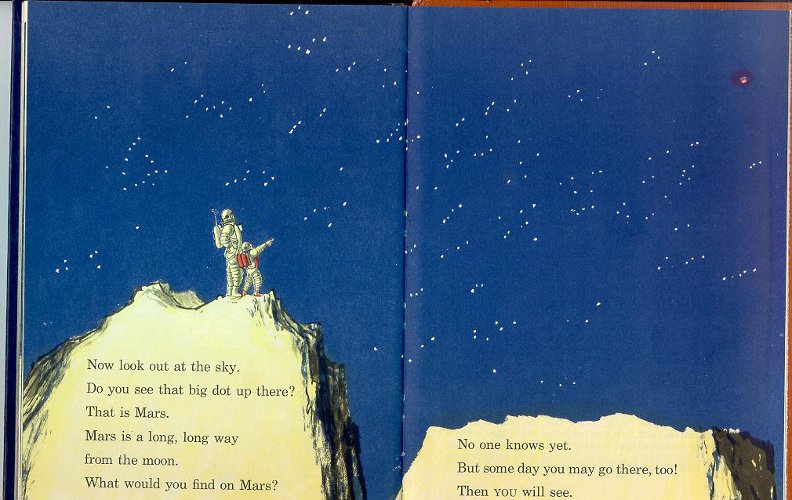
One of my most vivid memories as a child is resting in the back of my parents station wagon while driving back home to the city. The stars were so bright and the sky so black as I peered out the window.
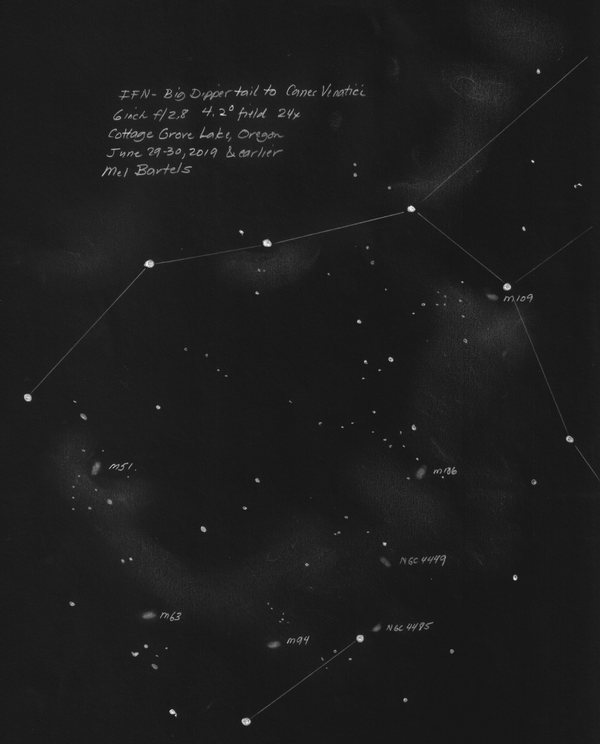
I've pioneered lightweight thin meniscus mirrored high etendue telescopes, using them to visually discover Integrated Flux Nebulae or galactic cirrus.
Interests in deep sky observing and cold camera astrophotography with homebuilt equatorials turned to large thin mirror grinding when I met John Dobson in 1981 and was given a night on John's 24 inch at Crater Lake. I have ground dozens of mirrors up to 30 inch in size and led mirror making classes.
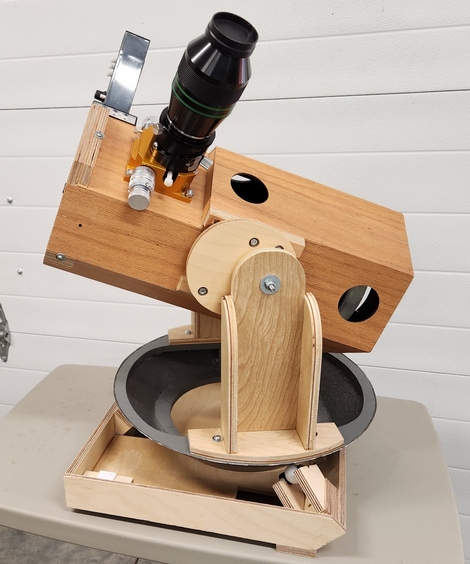
My interest in innovative mounting designs led to popularizing ultralights with single upper rings in 1994, inventing the TriDob in 2003, the ZipDob in 2009, the thee-axis double flex rocker in 2018, and the Pan Mount in 2024.
I developed an hardware and software open sourced telescope control system featuring software architecture innovations in the early 1990's that became popular worldwide. My wife and I formed BBAstroDesigns, Inc. (history is here) to sell kits. My github is available here. My computer controlled 20 inch won a RTMC Merit Award in 1995.
I've developed a version of the Ronchi test using software to null and thin the Ronchigram.
I ran the ATM list for six years. I speak at astronomical conferences and my telescope walkabouts are a popular highlight at the Oregon Star Party. I currently participate in the Oregon Scope Werks and Altaz Initiative groups.
I was President of the Friends of Pine Mountain Observatory and member of the year.
The I.A.U. named asteroid 17823 Bartels in recognition for my contributions to amateur astronomy.
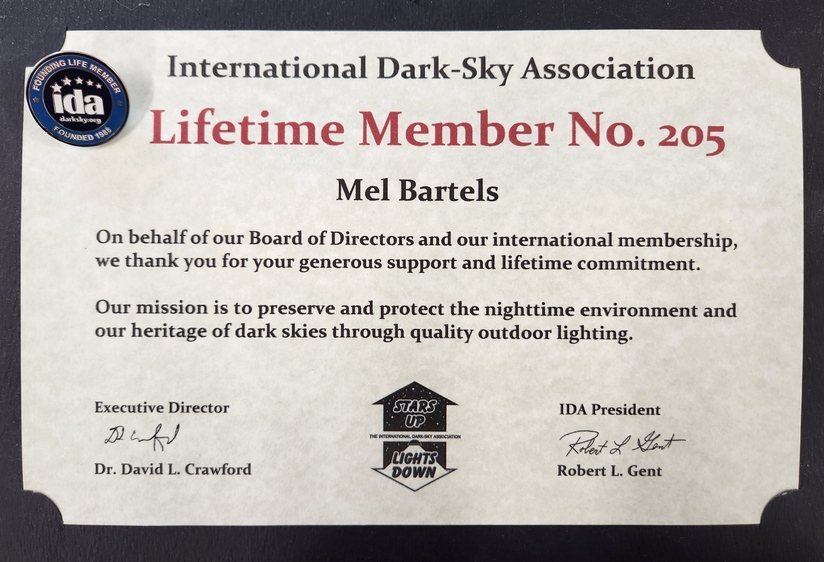
I'm on the Sisters Oregon Dark Skies Steering Committee
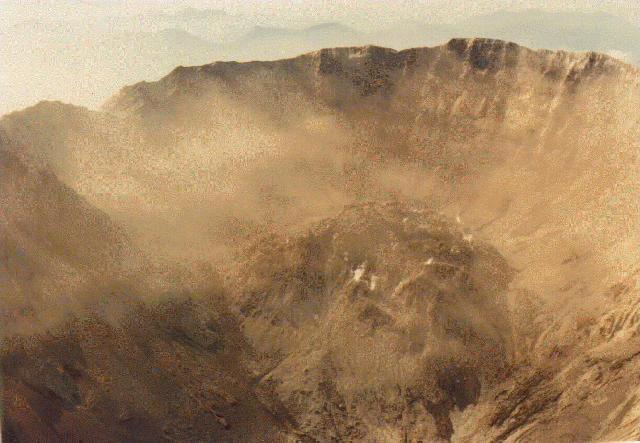
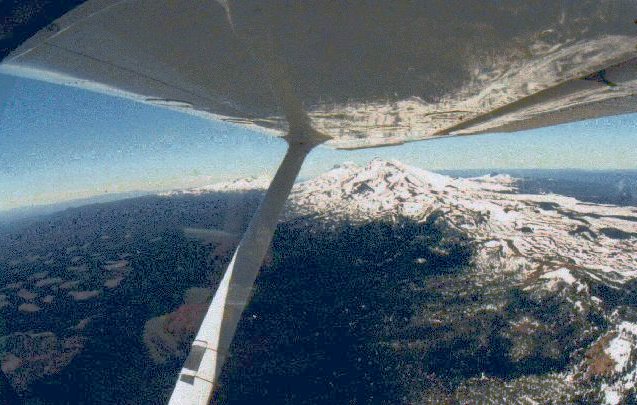
I hold a private pilots license. Flying over the rim of Mt St Helens shortly after the eruption and flying high over the Oregon Cascades